Starting a project with partners of different backgrounds, expertise and ways of working can be challenging: you need to understand each other, to get to know one another’s working habits, to see how you can complete each other in the project and adopt a workflow that suits all parties. When this does not work, tensions might arise out of misunderstandings, delays might occur out of incompatible working methods and, eventually, project objectives might not be achieved as partners’ ambitions differ.
At the same time, successful collaboration starts with taking the time to understand each other, discover how we work best together and develop a shared way of communicating and delivering.
In the EUI ZERO project, one way of addressing it was to organise a Word Bingo. As a tool to familiarise partners with each other and to adopt a common and jointly understood vocabulary, the Word Bingo is a grounding tool that should be applied by complex projects to ensure a good working basis as well as efficient and effective project delivery.
The need to get started on the right foot
The ZERO project focuses on co-developing and co-implementing solutions with residents for local energy transition. The innovation relies on combining social, governance and technological domains. As such, the project is composed of 13 delivery partners, covering the creative, engineering as well as public sectors. Working which such an array of partners on such a variety of tasks has created a complex matrix of interdependent and complementary activities. This led to a bumpy start where partners did not necessarily understand what the others were doing, with which methodology, the way they could complete each other, nor at which pace. This lack of understand and of short and long-term visibility created some tensions which needed immediate resorption. That’s where the Word bingo came into play.
A Word Bingo, what?
A playful but serious and crucial tool, the Word bingo is a methodology developed by De Vormforensen, an Arnhem-based graphic design studio, and used already in various complex environments of mixed partnerships. It seeks to reveal that words function in different ways for each individual. The process brings together different disciplinary perspectives, making visible the different forms of “common sense” that people bring to the same words. As such, the aim is not to create a dictionary with one “correct” definition for each word, but a project lexicon with different meanings and perspectives, such as practical interpretations, and questions.
In a project like ZERO with involves public servants, engineers, communication officers, designers, social workers and residents, energy transition and its related concepts can be understood in a multitude of ways. The Word Bingo can support building internal communication within the consortium, as well as external communication with the residents.
More generally the Word bingo can serve four complementary objectives:
- Building up relationship and perspectives;
- Getting to know each other;
- Defining common language; and,
- Having insights into different domains.
How did the Word Bingo operate in practice in ZERO?
The ZERO Word bingo was designed as a 1.5 hour and four-step workshop which took place on 15 June 2026, with 50 participants:
- Before the workshop, the organisers asked participants to send 20 words connected to ZERO;
- On D-Day, participants were given stickers corresponding to their sector(s) of activities: social, governance, designer, or creative domains. They were then mixed up and spread around eight tables;
- 30 most frequent words based on the sent ones were shared amongst the groups. Participants could exchange one of the three words they were given for a wild card. On this basis, each participant wrote their own definition and then discuss them altogether. They then agreed on a single definition for ZERO.
- All the definitions were brought together in a final session where an open discussion took place.
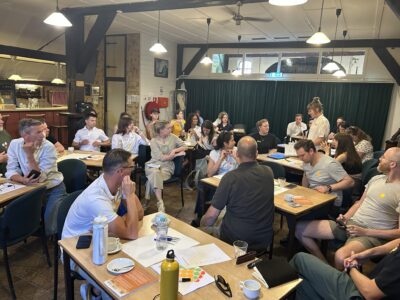
Word Bingo workshop on 15 June 2026 © De Vormforensen
What came out of ZERO’s Word Bingo?
At the end of the session, it appeared that all the shared definitions were different: participants used the same words for different meanings.
It appeared that the main challenge in understanding each other was not so much about the technical complexity of the vocabulary or the solution itself, but the biased understanding of everyday words depending on people’s professional language, culture, education, personal experiences, and values. Technical terms such as district heating network, solar panels, smart grid, and grid congestion generated quick agreement. Social-systemic and everyday words such as participation, energy, comfort, collaboration, and fairness, generated more variations and misunderstandings.
Of all the words, participation appears to have the widest range of meanings. It is interpreted differently across public administration, social workers, designers, engineers, and policy-makers. This makes participation a particularly useful starting point for developing a shared project lexicon.
Intervention also is also interpreted in different ways: from a targeted action to solve a problem or achieve a change in direction to a way of influencing behaviour, or as any deliberate form of involvement, such as a product, interview, or campaign. The differences mainly lie in the degree of direction, the intended goal, and whether behavioral change is necessary. An intervention therefore does not always have to be confrontational or problem-oriented; it can also focus on learning, development, and initiating positive change.
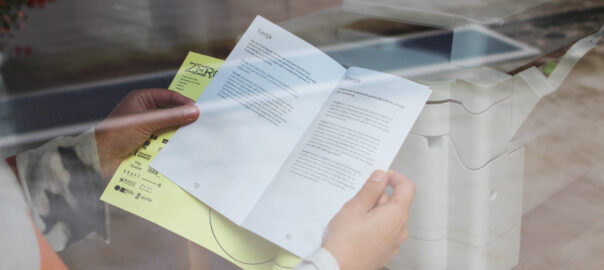
A lexicon has now been developed out of these discussions. It serves as both a baseline and a reference point for the next steps of the project. As a practical paper and pdf tool, partners can refer to it in doubt or to clarify some concepts they are using by themselves or during joint actions.
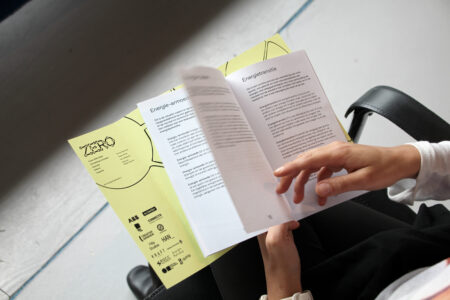
ZERO lexicon © De Vormforensen
How useful can a Word Bingo be for a complex innovative project?
A Word Bingo – and its output the Word Lexicon – can have the following usefulness:
- It is a key starting point: it serves as the baseline for the project’s research and analysis. It is particularly useful for a complex multidisciplinary project.
- It fosters inclusivity and integration: The Word Bingo provides an equal voice for all the partners.
- It fosters project cohesion: Everybody is part of the process and expresses themselves with their own professional and personal backgrounds, opinions and interest.
- It supports communication within the project and beyond: the work initiated within the consortium will then be expanded to residents.
Which specific methodology and skills do you need to lead a Word Bingo?
De Vormforensen, is a graphic design studio working with anthropological approaches. As a research method, they search for connections bringing people together around such projects. As non-experts, they work on reframing the working topics to ensure that everybody within the consortium and beyond understands different perspectives. They use the Word Bingo to reflect upon the graphic ways to share knowledge about the project. They are in position to be open and vulnerable themselves, which has enabled partners to adopt the same approach. This is also balanced with a humoristic approach. Kindness and honesty, within a safe space, are at the heart of the methodology.
The Word bingo to interact with residents
Working with the partners on the Word Bingo was key to create the project cohesion, now, the next step will be to create interest from residents on ZERO. Conducting this exercise with residents will add another layer and reveal whether the same words resonate with them, and what meanings and associations they attach to them. It will in turn support the campaign with the residents, in particular about the types of languages, text and imagery that can be used.
How can other cities and project carry out a Word Bingo?
The main challenge for carrying out a Word Bingo is its novelty, as a social innovation approach that many projects are not used to working with. It requires translation and training, time and patience to explain its added value and committee partners of a project to it.
Also, the exercise does not necessarily produce one “correct” shared definition but rather makes different perspectives visible and provides a basis for continued dialogue.
The main takeaways for other interested projects are therefore:
- Make it a priority: if you want to go for it, you need to make sure it will take place. You can, for example, ensure it is part of your grant application.
- Make sure to get the timing right: try and carry out the exercise as early as possible for it to be the most beneficial to the project. In any case, it’s better to carry it out later than never.
- Get enough time for preparation and exercise : ideally, you should list the initial words in person and continue during a workshop. You can split with a first online part (as in the case of ZERO) and then dedicate more and enough time for the in-person discussions.
- Remember that the Word Bingo is both process and end: it’s great to get a lexicon partners can refer to later on, but the exchanges and learnings, social bounding between participants is as useful as the final output.
Hopefully, this article will inspire other projects to carry out such needed grounding exercises. I would like to thanks Annelou van Griensven from De Vormforensen very much for her inputs on this article!
Reposted from Portico