The ZERO project is working with the Elderveld community in Arnhem to co-develop and implement solutions for local energy transition. Getting residents on board is therefore central to the success of the project and, for the first time, the Municipality of Arnhem experiments working with creative and artistic partners to engage the local community, raise their awareness and co-identify solutions to lower electricity peak demand, and avoid unnecessary grid expansions. In this Zoom-In, we present this journey, as well as its outcomes and learnings.
1. Who’s the team behind the artistic activities of ZERO?
Bureau Ruimtekoers is an Arnhem-based bureau for social design, social arts and participation. Three team members work on the project: Jente Poiësz is a theatre maker, Yosser Dekker – an artistic leader and Renee Janssen – a social anthropologist. Altogether they are providing the artistic lenses to the project. They are used to working with non-artistic organisations and in understanding systems and people, human interactions and their links with wider societal challenges. For the ZERO project, they have sought to “make people the ‘experts’” and not the ‘people we talk about’”, acknowledging that residents have knowledge which is as important as that of the ZERO partners. They are also seeking to make a big change for a smaller group of people, and to put the project into a wider societal need for change.
2. What have been the artist’s role and activities so far?
“ZERO is about building communities around energy-related issues. While current approaches often start with the topic of energy, we choose an approach that starts with building communities. This is about creating encounters, developing rituals, and sharing values. An important part of this is that, as programme makers, we respond to the needs of residents we meet along the way — even when, at first sight, those needs seem to have nothing to do with energy.
At the same time, it is important to approach energy as a topic — and even as a word — from the perspective of how the community itself understands it. This is the second part of our approach. We are interested in the knowledge and expertise that local residents already have around energy. By recognising them as experts, we learn to talk about the energy transition from the perspective of residents — and to have that conversation in and with the neighbourhood.” Yosser Dekker
Ruimtekoers is playing a role of programme maker inside and with the neighbourhood – it creates activities for the residents. It is also a connector – bringing together people from the street, with the neighbourhood manager and ZERO partners. It is also a builder of human energy, relying on the existing energy and trying to strengthen it. Through these mandates, the team investigates and seeks to understand the neighbourhood and energy transition. As of the beginning of the ZERO project, Ruimtekoers has focused on four activities.
Bakje LEUT is a free coffee and tea cart which invites residents to take a break to talk to each other in a playful and accessible way. It travels throughout the three main areas of the neighbourhood while staying two months on the same spot, each Wednesday.
“Artists are always part of Bakje Leut. It is not only coffee, it is an ‘excuse’ to create low profile and easy creativity with communities. The reason we created a coffee cart was that, during our first conversations, residents told us they were missing a place in the neighbourhood where they could meet over coffee. We responded to that need by creating a coffee cart.”
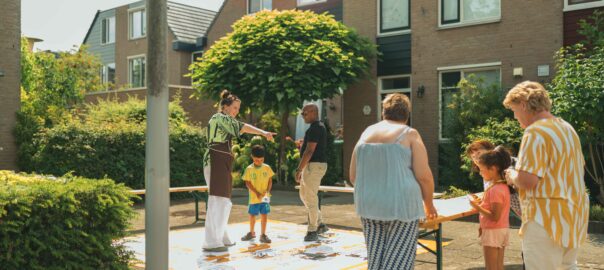
Mini street parties are events to celebrate the two-month station of Bakje LEUT. They also offer coffee and tea, organise playful activities and support exchanges with neighbourhood organisations.
Street parties are the moment where Bakje Leut ends in a given spot and when the community show their creativity, their stories and their talents. It is a celebration of their human energy.
Which neighbourhood animal are you? was designed as a game for residents to refer to an animal based about their own perceptions of their energy consumption.
The game came out as a result of the first Bakje Leut. A way the community wanted to represent themselves. Artist Alieke Geurts helped and designed with the community.
A Playful Solar Construction Site Intervention (Bouwplaats Zonnestad) stationed six times, once a month, in the Elderveld’s shopping centre to invite parents and children to build a solar city on a moveable workshop station on wheels.
“The reason we started Bouwplaats Zonnestad in the neighbourhood was because energy coaches asked for support in creating encounters with local residents.”
3. What have been the main results and what’s worked the best?
“In all of these activities, the conversation slowly but naturally starts to include energy. After all, energy is an issue that is already present in the neighbourhood.”, Yosser Dekker
Bakje LEUT has offered coffee to 254 residents so far, and the Mini-street party welcomed 60 people. 45 people joined the Playful Solar Construction Site Intervention. These activities have been a work in progress to deliver a blueprint for co-creation and participation which have already created outcomes useful for ZERO.
A large community of residents was created out of Bakje LEUT. Residents have already got connected with energy coaches and they will organise their own monthly gatherings, thanks to some extra funding received from the Public Housing company. This will keep the community dynamics, while further researching on values where ZERO can connect and leveraging for a first energy community.
Bakje LEUT was co-designed with residents who are already very active in the neighbourhood, so called ‘neighbourhood experts’. This collaboration has been very successful to identify common solutions to be implemented in the neighbourhood, where to install the of Bakje LEUT for example, how to interact with residents.
Mini street parties were co-organised with a dozen of residents and supported by local retailers (e.g plants) and human resources from local partners (e.g. a photographer active with the Salvation Army). The City Team Living Environment, Rijnstad, Public housing, and the Energy Bank also contributed to the event.
The Animal game provided the ground for open and honest conversation in a fun and sometimes surprising way, leading to deep learning conversations about energy and coexistence. Residents talked about their energy consumption, their perception of sustainability, and their experiences both as house owners or as tenants. The chosen animal became a mirror of their own experience which appeared to be an easier leverage to discuss energy than directly. For example, the Stubborn Woodpecker is determined and creative, hangs the laundry outside and looks for smart ways to use energy save. De Bouwende Bever knows what a heat pump costs per hour, likes to make his own decisions and pulls hard once trust is established.
The different activities have also put the residents in contact with Energy coaches who provide free advice for energy saving measures at home.
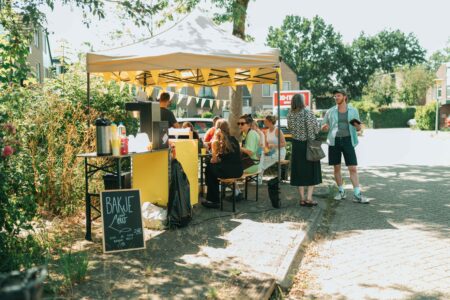
Bakje LEUT in Elderveld © Ruimtekoers
4. How artistic skills add value and complement that of the other partners of ZERO?
Adopting the artistic viewpoint in local projects stresses the importance that no local project should be carried out in isolation, form a purely institutional perspective. On the contrary, local projects are bound to reaction by external viewers and partners. Adopting such an approach “is all about interacting with people and how to strengthen society” says Jente Poiësz.
In ZERO, Ruimtekoers team members connected different worlds together and created in-between spaces where people can lose their role and interact with each other in the space that they create themselves. These spaces were also practice space, where they experimented, adopted a playful way to understand each other and the context in which we live. Together with residents and policymakers, Ruimtekoers they used imagination to create a tangible new future for equitable coexistence.
The other ZERO partners also took part in some residential activities to also get their own hands-on knowledge of the neighbourhoods and to connect with the initial learnings. Kraft Architecten will develop exhibition about spatial planning history of the district. Creative Arnhem will create an artistic project on insulation of houses. Ecoforma will contribute to the Repair Café.
5. What’s been the most challenging in the process?
A key challenge has been to identify ways to enable residents to understand how the energy systems work for them, and to build the digital and technological literacy needed to meaningfully participate in future governance models, such as cooperatives.
Another challenge has been to develop trust and collaboration in a partnership not used to working with artists and where technical and social partners might have felt at odds at the beginning. Partners have had to get to know each other and to find a common language, also to ensure that the added value of the work with residents will feed into the technical side, and vice versa – for the artists to understand the needs and requirements of the technical partners. Linked to this, the partners have had to learn to evolve within the, yet experimental, but strict framework of an EUI project with deadlines and deliverables.
On the other hand, working with residents has not been challenging as such. “There is always a part of risk, it’s an intrinsic part of the process” says Jente Poiësz. Getting to know the neighbourhood and the residents, identifying the right activities has been time consuming and tricky, but this is part of the process.
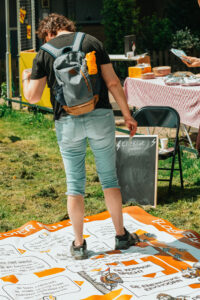
The animal game © Ruimtekoers
6. What are the main learnings and recommendations for working with an artistic approach in energy transition projects?
Be indirect. The four activities have been indirect entries into energy transition, creating trust, opening and a momentum that would not have been gained with an immediate talk on – potential unclear or unwanted – energy transition.
Use local knowledge resources. Neighbourhood experts expressed the need for a local café in the neighbourhood (there is none at the moment): that’s where the idea of the Bakje LEUT came from!
Focus on personal connections. After several visits at the Bakje LEUT, exchanges moved towards energy and the way they go about it. This approach created trust, a real care for the encountered people and collected personal stories and energy saving tips for saving energy. “Every conversation is as important as the other. Even if it is about dogs.” ” underlines Jente Poiësz.
Favour informal settings. Bakje LEUT and the Mini Street Parties enabled open interactions with neighbourhood professionals, energy coaches, neighbourhood managers, kids workers, social workers – a precious link for the future negotiations of the project.
Create specific activities for specific target groups. Here, the Playful Solar Construction Site Intervention was designed for children and their parents, a missed out target group up to that point.
Resident knowledge is just as important in the energy transition system knowledge. The energy transition takes place in their lives, and not in the reports or systems and as such, they should be central to local energy project.
Game provides a step forward and fun. The Animal game makes it easier to participate in conversation, especially when residents did not immediately think they have a position on the energy transition. The game appeared to create a tangible vision of the future, setting in motion to think about individual situations.
Create a solid ground of trust and co-working. Be open minded when working with your colleagues from other backgrounds, take the time to explain and learn from each other.
Experimenting yes, but within EU project boundaries. The project needs to be accountable and therefore needs to report accordingly.
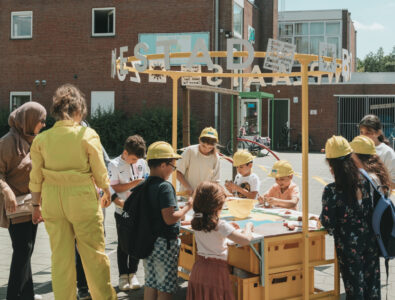
Playful Solar Construction Site Intervention/Bouwplaats Zonnestad © Ruimtekoers
7. What’s coming up next?
As Yosser Dekker frames it: “Building community takes time. Arts and play games have our attention. We now go forward in creating a process of getting people / residents / professionals together to create a game around sharing energy.”
The artistic activities have created a local community, which can be activated for the future activities of the ZERO project. In addition, it has collected stories, tips, wishes, frustrations and dreams which will feed into the research part of the project. Alongside the organisation of further Bakje LEUT, mini street parties and Construction Sites, residents will now start working with energy coaches. They will then be invited to be part of the further discussion of the ZERO project to install Smart Energy Management Systems or develop an energy cooperative. The next articles on Portico will give your more insights about these upcoming steps.
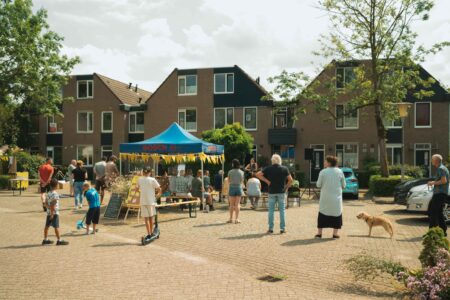
Street party © Ruimtekoers
Reposted from the Portico website