Monthly Archives: August 2026

Zoom-In 1 : Setting up a governance model to co design the future management of a district heating

It’s 2028. You are living opposite Park Maximilien in Brussels North District in a social housing. Next to you is the property manager of WhiteWood which hosts the European Commission’s Office for Infrastructure and Logistics in Brussels. Further away, a well-being officer from the ZIN a nearby coliving and office building…You have all gathered to discuss and exchange about the energy that you get from the Carbon Neutral Heating and Cooling Network set up as part of the EUI Be.SHARE project.

This was the initial vision of the Be.SHARE project: to embark users of the buildings connected to its Carbon Neutral Heating and Cooling Network (CNHCN) to make it more meaningful, while addressing directly all their varied needs. Now that the project was launched, the initial vision had to become reality. And for this, the project went on a co-creation journey to identify the actual forms such a governance could take, while precising its proposed ambitions, composition and mandates.

This Zoom-In deeps dive into the process for setting up this governance model: the initial scope and expectations, the co-creation process, the targeted groups, the baseline for the governance, and the eventual structure of the ‘Be.SHARE Lab’. We conclude by sharing some expected implementation challenges and their mitigation strategies as well some lessons for any other interested party.

1.    How did it all start?

Be.SHARE seeks to provide a collective solution to the decarbonation of cities by experimenting a fifth-generation Carbon Neutral Heating and Cooling Network (CNHCN) connecting a variety of buildings : a social housing, a building composed of a co-living, a hotel and offices, and office buildings. Its blueprint is to promote a meaningful,  just and inclusive energy transition, while developing a solution that really suits the needs of its users. To achieve this, the project decided to set up a long-lasting community around energy transition, bringing the social aspect (end-users of the energy) of the project closer to the technical part (CNHCN), reinforcing the idea of ‘nothing about us without us’. 

For the design of this community, the only requirements set out at the outskirts of the project were that it would fit in the project’s validation chain (from partners to Steering Group), that it would organise eight meetings throughout the project’s lifetime and that the meetings would involve a public-private-citizen partnership. The precise purpose, composition and focus of this community addressed still needed to be defined.

How can we give at this forum  its proper place while taking into account the various stakeholders and the complexity of the project framework? How can we ensure that members feel empowered to give their opinions and participate? And how can we identify topics that offer genuine room for manoeuvre? How can we ensure that it doesn’t become a mere formality? These were some of the questions which guided the work towards this community.

2.    Getting all the partners on board

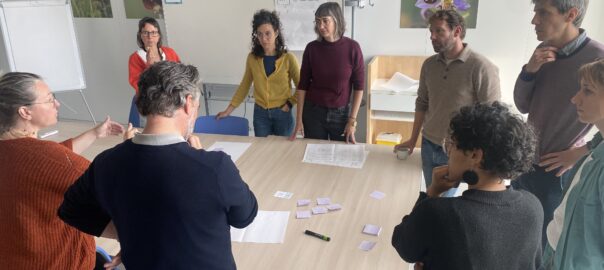
From the very beginning of the project, it appeared crucial to get all the partners of the project in the co-design of the community to embrace it and support it as well as to make it useful for them and the project. To carry out the co-creation, the project tendered an external consultant , 21 Solutions, who worked along the following stages:

  • A desk research and interviews created a first stakeholder mapping, identified objectives and concerns regarding the representativeness and governance of the community.
  • A consultation with a first circle of co-creators, composed of Brussels Environment, Be.SHARE’s project coordinator and Perspective.brussels (Public Participation Expert of the Region of Brussels-Capital and responsible for the tender for the process) then assessed the added value of the community, the topics to be covered and the composition.
  • These exchanges served as the basis for a consultation with a second circle of co-creators, composed of all the Be.SHARE delivery partners who further expanded on these.
  • These inputs let do the design of two scenarios for the community composition and framework, mandate, and basic operating rules. These were debated back with the second circle.
  • third scenario merging the concerns and interests of the previous scenarios was then proposed and validated by the Be.SHARE partners.
Be.SHARE Joint Committee on 13 May 2026 © Marcelline Bonneau

3.    How to compose a meaningful group? 

The stakeholder mapping identified six target groups concerned by the CNHCN: everyday users, with their experience-based knowledge (residents of social housing and of the coliving), intermediary representatives, acting as mediators and relays (communication managers, well-being officers, social workers, trade union representatives, …), operational managers with technical expertise (technical managers, property managers, asset manager), economic decision-makers in charge of strategic decision-marking (office managers, shareholders, representatives of the Social Housing Company), public representatives and local stakeholders, anchoring the project locally (City of Brussels, Up4North – non-profit association created by district’s promotors,  perspective.brussels , civil society) and the Be.SHARE project partners.

A main challenge was to identify which ones to work with as partners agreed about the impossibility and lack of relevance to work all of them all the time. Yet, they recognised the need on the one hand to ensure if not representativeness at least sufficient diversity and, on the other, to prevent from the risk of self-censorship or power imbalances if a hierarchy is present.

As such the sampling of members of the community was decided to ensure that all participants would have an equal voice, while some actors carry institutional legitimacy (Flemish Government, City of Brussels,  building owners) which carries different weight. The community would also articulate real-life experience and technological one without weighting one more than the other.

4.    Defining a governance structure which makes sense: the Be.SHARE Lab 

The partners agreed that the community should enable identifying blind spots , forcing the CNHCN to be adapted to the on-the-ground realities. At the same time, it would become a network of local stakeholders, a platform for learning for technicians as well as for users, altogether being a space for mediating expectations, misunderstanding or conflicts. It would also make the project partners accountable and transparent. It is hoped that by being part of the community, its members would more easily understand and embrace the CNHCN. Last but not least, partners agreed that the community would become a place to test, and be open about adjustments, in a mutual learning environment.

This led to the design of the community as the ‘Be.SHARE lab’,  a bidirectional transmission belt and improvement laboratory. It will be composed of maximum 30 members, with  everyday users,  intermediary representatives, operational managers, local stakeholders and the Be.SHARE partners. Economic decision-makers will be invited upon request.

The aim of the Be.SHARE Lab will be to circulate information in both directions—from the field to the project AND from the project to the field—and to transform this feedback into levers for continuous improvement. The Lab will not be solely consulted: it will act as a sensor of reality and a catalyst for adapting the project, serving as a testbed and enabling the research to evolve.

The Be.SHARE partners will incorporate the Lab’s feedback and proposed concrete adjustments into operational decisions and deliverables. They will also relay those through the validation chain (up to the Steering Group).

5.    Expected challenges and mitigation strategies

Be.SHARE’s project partners already expect that the Lab’s members will have high expectations regarding the usage of their inputs: not following them by visible results might erode their motivation and feeling of legitimacy. To limit this risk, a formalised feedback loop will make the impact of the Lab’s input visible.

In addition, to prevent raising expectations that the Lab will be unable to meet, having an advisory role only,  existing room for manoeuvre (e.g. commercial contracts, regulations, etc.) will be made explicit,  also distinguishing between “contributing to improvements” and “making decisions”.

Another risk, common to all participatory process, will be to lose participants from one meeting to another. It will be addressed by maintaining momentum between meetings, for example through the awareness-raising activities for a wider audience or through effective report that will allow potential new members to join the lab. In parallel, members will also become relays of information to their pairs and as such will be active (and actors), in-between meetings.

Also, favouring regularity over the project pace might miss the need for inputs at crucial moments of the project. As such, the meeting frequency will be adjusted with the project pace, implying for example an initial setup phase requiring frequent input followed by lighter monitoring from the Lab.

Another challenge will be that some participating members might have a louder voice. To prevent this power imbalance, the rule of equal weight has been installed, together with professional facilitation to ensure smooth exchanges.

Last but not least, the original vision calls for evaluating ways to ensure the community’s long-term sustainability after the Be.SHARE project. The way it can be sustained will be co-created by its member throughout the meetings.

6.    Main lessons learnt from the co-design process

The main lesson learnt is that co-designing such a Lab enables questioning the projectaligning the partners and making the project’s theory become concrete. It really sets out altogether and openly what such a Lab can be or not, which topics could be covered or no. It also moves beyond the idea of reaching the perfect model, but finding a tailor-made and tested one.

Another major learning is the time such a process takes, from the launch of the project through the Procurement to initiate the co-creation of the community (four months) to the call for participants (eight months), and that would need to be anticipated further in newcoming projects.

Only experience will tell whether this model works effectively. Yet, partners hope that the transparency about the framework (terms of reference), facilitation techniques, frequency and format of meetings, feedbacks on inputs, as well as the overall feeling of belonging to a community (e.g. via in between meeting interactions), will make a difference to the deployment of a just and fair CNHCN.

Mapping of stakeholders © 21 Solutions

7.    Next steps : the real-life test of the Be.SHARE Lab

Now that the governance model of the Lab is established the recruitment and activation of its members is about to start.  As of July 2026, potential members will be targeted through the existing activities of the project (ongoing projects with the social housing) and new activities, as well as bilateral discussions, running a booth on-site,… A tailor-made and accessible information will be shared. Pedagogy, enthusiasm, and transparency will be key words for explaining the governance model.

Late 2026, the first meeting will take place to frame the work, create trust and launch collective functioning. Technical details about the CNHCN will also be presented together with the first discussion points.  In 2027 and 2028, six meetings will be organised including a mid-term evaluation, with new recruitment if need is!

Stay tuned via Portico and via the Be.SHARE newsletter to be informed about these next steps!

Thanks a lot to Alessandra Kegeleirs (21 Solutions), Vincent Vandernoot, Hélène Dekker and Céline Dutry for their insights in the drafting of this Zoom-In!

Be.SHARE’s co-creation on 19 January 2026 © 21 Solutions

Reposted from Portico