Grid congestion is the reality of any country engaged in advanced energy transition. That is the case of Arnhem, Netherlands. Increased electricity demand bound to the limits of the current grid partially explains this but improving technical infrastructure alone will not solve the problem. Inequal access to expensive solutions, as well as the lack of awareness and subsequent appropriate behaviours need to be part of the equation as well. And that is what ZERO (citiZen-centric Energy gRid Optimization) is seeking to test.
In this First Chapter of the Urban Diary, we will go through the rationale for going on such an adventure, discover the tested solution and the partnership behind it. We’ll hear from the first impacts, learnings and challenges faced throughout the first year of the project. Let’s discover some solutions which might be needed by all EU cities in the upcoming years!
1. Elderveld is an ideal test bed to address grid congestion in Arnhem
With the rise of electricity demand and related risks Arnhem has chosen to optimise its electricity grid. While ZERO aligns with national regulation (Dutch Climate Agreement and the Gelders klimaatplan 2021-2030) and is part of national prigrammes (Dutch Authority for Consumers and Markets’ policy for fair network tariffs and Aardgasloze Wijken program), it also support Arnhem’s Energy for Arnhem strategy and its Area Energy Plans by acting as a testbed for targeted neighbourhood action.
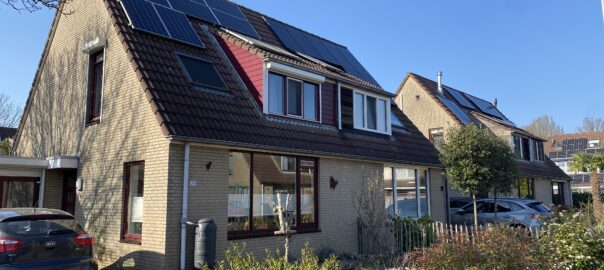
Elderveld is a green residential area in Arnhem South, with around 8,800 residents and 4,240 homes, 70% of them single-family houses. Built in the 1970s as a post-war expansion area, , it struggles with the energy transition. Lower-income households, with an average income of EUR 29,000 per capita, are less engaged, while awareness of grid congestion remains limited. This lack of engagement exacerbates social disparities, hindering Arnhem’s goal of an equitable energy transition. Without inclusive, citizen-driven solutions, residents risk missing the benefits of the transition and bearing disproportionate costs.
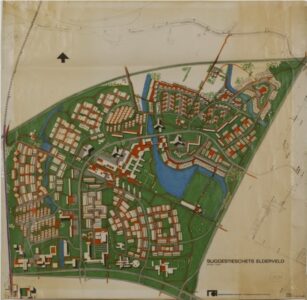
Elderveld, a cauliflower-type neighbourhood © ZERO
2. ZERO’s innovative approach
Traditionally, projects addressing grid congestion are technology-led, top-down, and oversee end-users, especially those of more deprived neighbourhoods. By shifting this approach to make it bottom-up, residents-owned and combining a technical, a social and an organisational and legal component, ZERO will test a new approach through the ZERO pilot, leading to the design of an Urban Energy Covenant.
The technical component implements engineering and electrical works. It also creates knowledge, which raises awareness and supports decision-making – and thereby linking to the social innovation component.
The social component designs and implement social interventions to create support and empower citizens in developing a community-driven local energy system. Activities are organised at different steps of the participation ladder: information and consultation, co-creation and co-decision.
The organisational and legal component focuses on the structure and framework to establish an energy community with Peer-to-Peer (P2P) Energy sharing network and a reward system.
The ZERO pilot itself will bring together the analysis of the three (technical, social, and organisational) components to feed into a digital twin (used as an informative and decision-making tool) and an Urban Energy Covenant.
The Urban Energy Covenant will propose a framework to optimise grid performance and minimising costly expansions through the implementation of an Energy monitoring and behaviour pilot, a Reward program pilot, and a P2P energy sharing pilot.
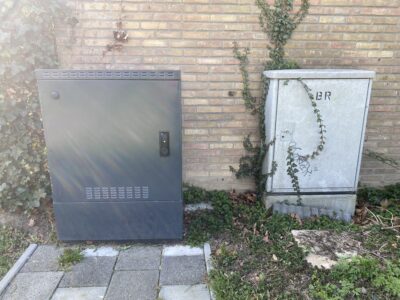
Feeder Pillars in Elderveld © Marcelline Bonneau
3. They are ZERO!
ZERO is one of the most complex EUI projects, covering a range of required skills:
- The project is coordinated by the Municipality of Arnhem.
- The analytical integration, transfer into the digital twin, evaluation and monitoring are mostly implemented by Hogeschool van Arnhem en Nijmegen and Fillip Studios.
- The organisational component of the reward programme and energy community is implemented by Social Finance NL and ROCC.
- The technical aspects of hardware, data collection and management, buffering solutions, link between measurement data and decision-making is mostly implemented by Connectr, ABB, Luminis Technologies, and Alliander.
- Communication is in the hands of Creatief Arnhem and De Vormforense.
- Identifying resident’s needs, interests, co-creating with them and translating these into scenarios for the pilot and the Urban Energy Covenant will be organised by Rosalie Apituley, Ecoforma, Ruimtekoers, Kraft architecten and Radboud Universiteit Nijmegen.
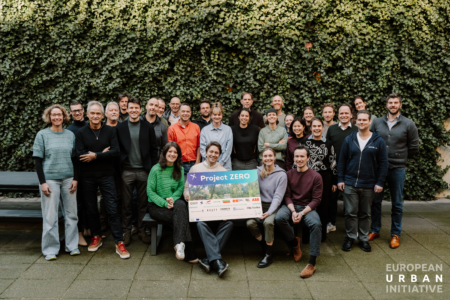
ZERO project team © Michèle Giebing
4. This has been the first year of ZERO
During the first year of the project, the partners have focused on laying the ground for the project, analysing the issues at stake, the profiles of the neighbourhood and of the residents, initiating some community activities, as well as setting down the technical requirements for the next steps of the project.
Partners got to know each other through a Word Bingo exercise. Some confusion had arisen in the project because of the different usages of terminology and words. Through exercises on words related to the project, all the partners got the opportunity to reflecting about what the project meant to them and what it was really about, not only for them individually, but for the group as a whole. The exercise led to the creation of a lexicon for the project which will be used as a baseline for the project as well as for the co-creation with the residents. It has set a positive and constructive ground for improved collaboration between partners. (more details about it here)
Residents have been reached out through a series of activities and the dynamics around ZERO has kicked off. In particular, welcome cafes (Bakje LEUT), Street parties and Playful Solar Construction Site Intervention were organised. Using different formats, and an artistic approach, project partners created community moments for residents to create trust and confidence. Shifting the perspective from engaging residents around the energy topic to providing a space to meet and exchange, with personal connections, and a playful approach modified the usual ways of working of traditional municipal projects. In turn, a solid baseline for further discussions about the energy transition is now in place (more details about it here)
Based on these activities and on 54 individual interviews, a first overview detailed the way residents consume or save energy, are threatened (or not) by energy poverty. Bringing in academic perspective into the project, this analysis will on the one hand inform the design the energy communities with co-creation at the centre, on the other, stimulate citizen participation in the energy transition. The scenarios proposed by residents exemplify potential solutions which are not only technocratic and quantitative, but also social and qualitative. In turn, these might appear to be cheaper, more sustainable, and stimulate more citizens’ approval and acceptance of ZERO strategy. These could for example be a platform where residents document and share their practical energy knowledge, using a digital twin to visualise the impact of their individual and collective practices. These could also be co-design sessions where residents would define what they actually need from energy renovation (warmer/cooler homes, lower bills, less disruption, etc.) or co-design technologies relevant at building or street level rather than individual household level.
Thanks to these inputs and additional analysis, a first scenario for the design of an energy community which could take the form of a cooperative with participants from Elderveld has been designed, where the project would be owned by residents and supported by the Municipality. At the moment, the theoretical model describes the stakeholders to be involved and identifies the interventions that are necessary for this.
The outreach activities have also supported the identification of residents who would be eager to install Smart energy management systems. In 10 initial households, a (simple) monitoring system has been installed to learn from the data flows it can generate and to investigate if, and to what extent, this contributes to awareness of energy use. Technical data from the neighbourhood is now in place and partners can start analysing precisely and quantitively energy consumption. 70 more households to go!
A first sketch of the digital twin has been drafted. It will enable visualising data from individual homes: energy consumption levels, points collected through local activities (e.g. attendance of neighbourhood meetings…) , calendar of events (e.g. an energy market), products which can be bought (e.g. smart energy monitor cabinets, floor or roof insulation panels, …), and some stories or interviews. Partners are currently discussing both the content of the format depending on their own needs and of the project as a whole.
The neighbourhood was thoroughly analysed on its history, identity and current dynamics, with the identification of potential scenarios to host the future ZERO energy Community Centre (for example linked to a central sports hall which used to be a community centre, and which all residents know ). These scenarios are currently being reviewed by a group of stakeholders and partners of ZERO. An exhibition about the history and use of the neighborhood is also being prepared based on this rich knowledge.
Scenarios for the reward programme comparing financial schemes are still ongoing. Energy personas have been designed leading to the design of a fair and equal social financing model for Elderveld and of a theory of change to ensure long-term impact of the programme: concrete behaviour change when it comes to energy use (countering grid congestion). Work is now ongoing on identifying actions that can be rewarded.
Last but not least, ZERO is keen to reach out to unusual suspects, to those residents most commonly not taking part in municipality-led participatory or energy focused activities. For this, it used, once again, an artistic approach and created a photo exhibition together with women from a language class in Elderveld: these women, who do not yet speak Dutch well, show how they experience energy in their neighborhood.
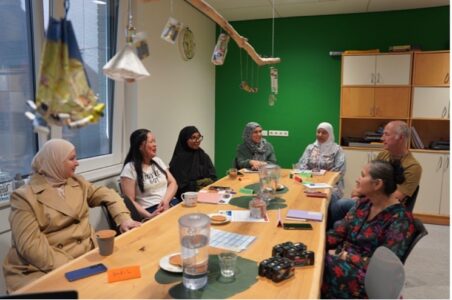
Photovoice workshop, as part of research, 18 June 2026, Klimboom School © EUI ZERO
5. The unexpected potential of ZERO
The key lesson from ZERO’s first year is that the project truly operates as a living lab—within the partnership, the neighbourhood and each participating organisation. Partners expected a great playground for experimentations in testing approaches that are difficult to apply through standard policy or implementation processes, while developing a proof of concept for tackling grid congestion. What they discovered is that the challenges themselves are part of the experiment: solving them is central to the project. For example, how can the project reach out to residents? How can the digital twin become meaningful for both its users and the project? What information should be displayed in which format and which accessibility? How can the project ‘convince’ residents to install Smart Energy Management Systems at home? What would be the best location for the ZERO Energy Community Centre, which form would it take, with which activities?
Seeing ZERO as a living lab has therefore shifted the focus from simply implementing a predefined plan to actively testing it in practice. Some delays have already emerged in the implementation of project and should be seen as part of the experimentation, forcing the municipality and the partners to develop agile resilience strategies.
In other words, the project will not unfold exactly as planned on paper but will seek to come as close as possible through experimentation, through learnings presented in the next section.
6. What’s been challenging and how ZERO has overcome it
Strategic integration
Several municipal and partner-led initiatives, including the launch of the Energy for Arnhem strategy, were already under way in Elderveld, when Arnhem launched the project and positioned the neighbourhood as a test bed. As their links and room for manoeuvre were initially unclear, raising partners’ expectations, the first year focused on mapping activities, aligning expectations, clarifying the municipality’s role and connecting policy with action. A new governance model is now in place, with tools to better integrate ZERO internally and with local initiatives.
Partners’ diverse profiles created different expectations: technical partners lacked clarity on when their work would begin, while some social partners felt overshadowed. Alongside project management tools, tools such as Word Bingo helped build shared understanding and ground for better collaboration.
Partners identified recurring challenges in co-creating with residents: building trust, remaining sensitive to local realities, avoiding resident overload and working with the ‘usual suspects’, and sustaining long-term engagement.
To address this, ZERO worked closely with the Neighbourhood Manager, who knows the reality, people and place from their daily experiences, and used ‘unusual skills’ to reach residents, build lasting trust and created tailored communication through anthropology and ethnogeography.
Getting technical messages across
Another challenge has been to enable residents to understand how the energy systems work for them, and to build the digital and technological literacy needed to meaningfully participate in future governance models, such as cooperatives. Partners have started to work on this while combining skills and translating to each other their own realities: technical partners explain the technology and information systems to social partners, who in turn can explain the realities of residents as well as the best ways to communicate to them. Communication tools are still being designed to merge this knowledge to share messages in the most efficient way.
A meaningful reward system
Partners were concerned that the reward system should reflects citizen realities, would be perceived as fair, and would not exclude households with lower flexibility capacity. It also had to maintain a tight ‘theory of change’ from congestion problem to measurable household actions with reward logic, avoiding over-complexity in the incentive design. Even though the design of reward system is not finished yet, moving beyond a pure in-house desk research and literature review to using the inputs from the various interviews and street activities as well identifying energy personas have both provided depth to the potential of the proposed solution.
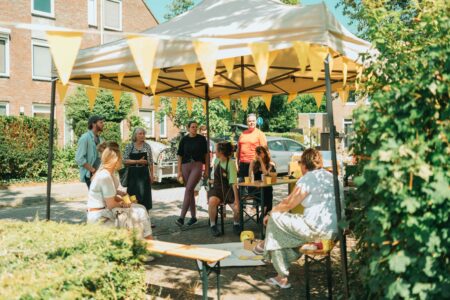
Bakje LEUT in Elderveld © Ruimtekoers
7. If ZERO could share some tips with other cities…
It’s only the end of Year 1, but looking back, here are some main learnings that could be shared with other cities interested to embark on a similar journey:
- Don’t underestimate the complexity of such projects! You have decided to combine technical, legal, organisation and social solutions in one? It’s amazing! And so relevant! But, beware, that such an integrated approach is still a novelty for coordination as well as implementation, which requires timely nesting of inputs into one other, supported by ongoing openness and readjustments from all the partners…
- Talking about communication: Partners will need to understand each other, to get into each other’s reality, to find a way of working that work for all of them. Only while being open and honest, transparent and humble can it work. Tools like the Word Bingo will be great assets.
- Delays can be part of the project : but they need to be clarified, explained and caught up! Some partners will be waiting for inputs which might impede the whole process in case of further delays. Don’t forget to use validated project management tools.
- Be creative in working with residents! Engaging (all) residents is a difficult to get the Holy Grail in all participatory projects. Using artistic skills (through Bakje LEUT, street parties, the photo exhibition .…) have provided an unusual perspective on reaching out strategies, unsettling at first, efficient in the long run !
8. Heading towards Year 2
Year 1 of ZERO has been about setting the ground for projects, together with strengthening its integrated approach leading to the reinforcement of the team: with coordination, communication, getting to know each other… Data has now been gathered, theoretical scenarios are in place, residents start to get familiar with the project.
During the second year of the project, the project will continue analysing the neighbourhood and working with residents on the solutions which best suit them. It will also design energy awareness and behavioural change designs. The main highlight will be the opening of a Community Command Centre and the launch of the community information campaign
It will also start implementing the technical solutions such as Smart Energy Managements system in additional households and will continue working on the design of the data management and buffering systems. It will also finalise the reward programme. At the end of the second year, the baseline will be in place to integrate all these elements into the ZERO Digital twin and pilot the Urban Energy Covenant.
9. To conclude
Addressing grid congestion is definitely not a pure technical problem. It requires strong social skills and knowledge, and to be humble: it will ask you to work differently! But once it is on track and that you know that collaboration with different partners be part of the journey, you can be sure you’ll be rewarded and be ready to harvest some fruit! Check out the next publications to update yourself on the other learnings from the project!
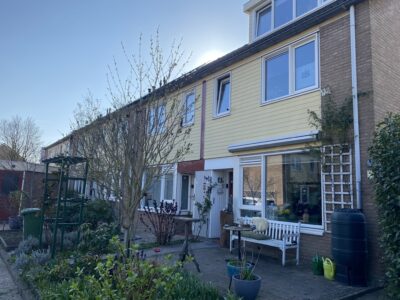
Elderveld © Marcelline Bonneau