The Be.SHARE project was launched in October 2025 to test a local, low-temperature Carbon Neutral Heating and Cooling Network for the Brussels North District. Whereas previous publications have already shared about its policy context and potential, the ambitions of its technological solution and the set-up of the governance model including the users of the future network , this first chapter sets out the details of the project, the partners involved and the envisaged the impacts of the project. It then analyses the initial challenges faced by the project, with the main lessons learnt and concludes on the plans for its second year.
1. A favourable but fledging policy context
As described here, the Brussels-Capital Region aims to accelerate the phase-out of fossil fuels for heating, which requires a major shift in how residents heat and cool their homes and how businesses heat and cool their offices. The regional Task Force Energy 2050 has shown that renewable local heating networks could play a key role in providing carbon-neutral heat across the territory by pooling decarbonised energy resources available in the public domain and offering a collective solution.
The North District of Brussels is a post-World War II district, originally developed as a business district. Over the years it evolved into a mixed-use neighbourhood that accommodates residents displaced from the older part of this district by urban regeneration and includes a central park, the Maximilan Park. A dense and multifunctional area with varying energy uses and consumption patterns (between long-term and short-term residents, as well as office workers) and with buildings mostly still largely using natural gas for heating, it is difficult for users to access decarbonised energy on their own plot. This makes this district is an ideal test bed for a carbon neutral heating and cooling network (CNHCN) that matches the supply and demand, contributing to a more sustainable city.
2. Be.SHARE in details
Be.SHARE’s innovation lies less in the 5th generation CNHCN technology than in using public decarbonised resources and in raising regulatory, ownership, management and maintenance issues. Its implementation in a dense area will be challenging, while end-users, especially social housing residents, must remain at the centre of the project. The project aims to show that a low-temperature network using public carbon-neutral sources can balance energy supply and demand in mixed-use areas. It can be described following its main six components.
- The technological solution
Be.SHARE will deploy a 5th generation carbon neutral heating and cooling network (CNHCN) using public renewable resources from the public domain, through geothermy and riothermy, and additional heat pumps. Several buildings will be connected to the system as prosumers and/or consumers: two office buildings, one co-living and two social housing buildings.
- Designing a legal framework for the use of public renewable resources
In order to exploit the public resources available below ground level, agreements will have to be put in place to allow operations: between the owner of the land and the producers of geothermal energy, between the operator of the sewage network (Vivaqua),which installs riothermal energy and the network operator, between the producer of geothermal energy and the operator, and with the social housing provider for a social energy tariffication. The agreements will cover the legal and regulatory approvals for potential environmental impacts and work in the public space as well as adherence to legal standards throughout the construction phase.
- Designing a viable Business Model
Be.SHARE will establish for all investment parties a fair operational model for the post-project operation of Be.SHARE, within a context of uncertain maintenance costs. Commercial calculations and models will be compared for different profiles of operators (public and private), taking into consideration both social tariff arrangements and technological requirements.
- Quadruple helix partnership
The Be.SHARE partnership is composed of public and private, a non-profit organisation and academic sectors, combining expertise in urban planning, engineering, energy transition, social issues, and energy consumption. Core partners will be responsible for the day-to-day implementation of the project, while associated partners will contribute through the use of and connection to the CNHCN. They will learn and exchange viewpoints, expertise, and ways of working (e.g. agility vs procedures).
- Public-Private-Community governance model
Be.SHARE will involve civil society, end-users and local institutional stakeholders from the very beginning of the project alongside technical experts. They will exchange around the future operation of this type of solution in a more cooperative manner benefitting from maximum transparency by debriefing on technical matters, risks and constraints.
- Raising awareness about energy consumption
Be.SHARE will address sustainable transition through a wider approach to behaviour and energy use, including aspects related to comfort, energy consumption and improvement of indoor air quality. All buildings users (social housing residents, co-living residents and office users) will be engaged through three levels of participation: information, engagement and empowerment.
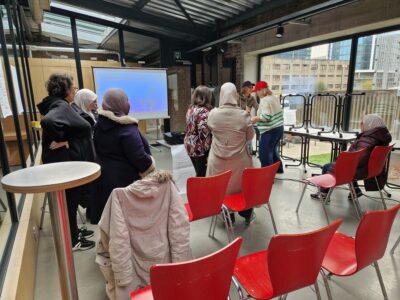
Workshop with social housing residents, 31/03/2026, Pôle Nord © EUI Be.SHARE
3. Who’s behind Be.SHARE ?
Be.SHARE is being implemented by six complementary core partners :
- The coordination of the project is ensured by Brussels Environment, the administration responsible for implementing Environmental policies for the Brussels-Capital Region.
- The technical design and implementation of the project is done by Vivaqua, (Brussels-Capital Region’s public operator for water and sewage system), Sibelga (Brussels-Capital Region’s operator for gas and electricity distribution network) and Karno (private project developer)
- Working with residents of social housing is in the hands of Convivence asbl (nonprofit organisation supporting better housing conditions)
- The project is monitored and evaluated by the Vrije Universiteit Brussel(VUB)
Other partners are associated to enable access to geothermal resources (City of Brussels), to underground infrastructure (Bruxelles Mobilité, Regional administration responsible for mobility, manager of large public roads), as well as those managing buildings connected to the CNHCN: Foyer Laekenois (social housing provider) , Whitewood (owner of the office building) and Befimmo (owner of the office building, the hotel and the co-living building).
Be it for influencing governance and policies or developing new technological or social solutions, partners have all expressed a high motivation to be working on an exemplary project while addressing the Brussels-Capital Region’s decarbonisation challenge. They seek to increase knowledge about district heating networks – a necessity for the future – as well as to set a positive precedent. For them, it will be a solution to ensure a just energy transition for the region, specifically for densely built-up urban neighbourhoods. It will experiment balancing strong innovative aspects across technical, legal, and governance dimensions.
Thanks to the EUI funding, they feel they will be able to work concretely and at the very local level, a field-based project to be rolled out through a solid partnership involving a diverse range of key stakeholders in the Region, with a unique replication.
Last but not least, partners welcome the inclusion of social housing residents in an innovative project from which they are too often excluded.
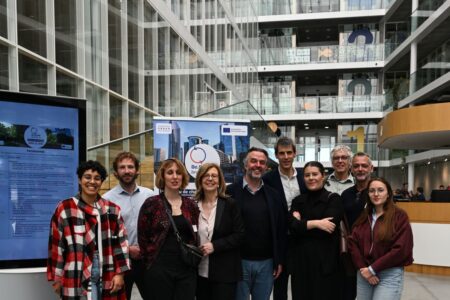
Be.SHARE project partners © EUI Be.SHARE
4. What difference can Be.SHARE make ?
Be.SHARE covers five types of innovations: technological (the technical and engineering design of a CNHCN using geothermal and riothermal energies), legal (the legal and commercial agreements to access public resources as well as to distribute them), economic (financial aspects of the business model and the tariffs), governance (the roles and missions of the various stakeholders) and social (the end-users, in particular from social housing). Each of these innovative components are linked to each other. For example, the technological solution cannot be implemented without permits and agreements, a viable business model, supported and informed by the partnership and with the involvement of the end-users.
The ambition of Be.SHARE is to analyse each aspect in an untangled way while at the same time stressing their strong interdependency!
The power of the technological innovation
Although the 5th generation CNHCN is not innovative in itself, Be.SHARE will test its timely, resident-accepted deployment and demonstrate:
- The feasibility of developing heating and cooling networks in urban public space;
- Their viability in dense urban areas;
- Their accessibility and affordability to all residents and users, including for vulnerable groups, in a Just Transition Approach;
- Their role as a decarbonisation solution in efficiency, CO2 impact and cost;
- The value of local renewable sources such as geothermal and sewer-based energy for energy transition.
It will also define deployment conditions and identify key barriers and enablers.
Exemplifying a societal and collective solution
The project will highlight the environmental and sustainable value of a collective, low-temperature district heating network compared with separate fossil-fuel phase-out solutions for individual buildings. Over time, it could make collective infrastructure a more realistic model for urban renovation and new developments.
Steering regional governance in terms of decarbonisation
Be.SHARE will support regional heat decarbonisation by helping strengthen rules for heating networks, ensure implementing the Region’s strategic plan for heat decarbonisation and clarify the roles, responsibilities and frameworks needed to deploy such solutions.
Supporting the legal framework
Be.SHARE will also enable the Region to support municipal authorities (such as the City of Brussels) and serve as a model for them: it will inform the processes of amending regulatory frameworks and establishing authorization mechanisms for both the deployment of district heating networks and the implementation of geothermal drilling on public land.
Towards equity and inclusion
The project will seek to demonstrate that the energy transition can be inclusive and fair, in particular by working closely with those usually excluded from such processes and by implementing a social tariff.
5. What’s happened this year ?
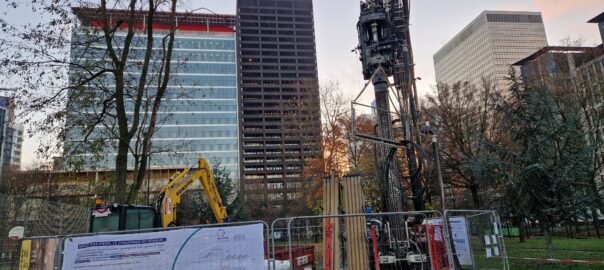
During the first year of Be.SHARE, partners prepared and validated the designs for the CNHCN, leading to an in-depth thermodynamic simulation. The first drilling tests took place in winter, enabling the project team to finalise the technical schemes and requirements for the implementation of the geothermy.The baseline is now finished and a public procurement has just been launched to start of the construction of the network.
In parallel, the project is investigating the creation of a Special Purpose Vehicle as an organisation to be in charge of the network, composed of Sibelga and KARNO. The main question at this stage concerns the clarification of the respective roles and responsibilities of the two partners, taking into account the regulatory framework as well as the remaining technical and financial uncertainties.
Karno and the City of Brussels signed an agreement granting the use the geothermal resources under the Maximilian Park through a state land concession. It will last for the duration of Be.SHARE (until 31 December 2029) plus an additional five years.
After a series of workshops with the Be.SHARE partners, the governance with users of the connected buildings (initially a Public Private Citizen Partnership) has taken the shape of a so-called ‘Be.SHARE lab’, which will ensure a ‘bidirectional transmission belt and improvement laboratory’. The recruitment of members of the lab is now ongoing, with activities expected to start late 2026.
Alongside the project, the social housing buildings have started undergoing major renovation works including facades insulation: Be.SHARE partners are on the frontline to communicate about it to residents and to address their questions. Residents have now been engaged through different formats (workshops and home visits). The first discussions explored how residents use energy within the constraints of their homes and to which extent they can adapt their behaviours and consumption patterns.
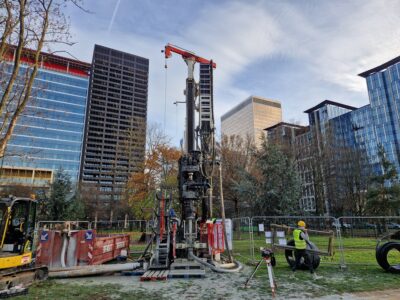
Drilling test on Maximilian Park © EUI Be.SHARE
6. What have been the main challenges and learnings so far?
In its first year, Be.SHARE has faced challenges from which other interested cities could learn.
Managing a complex partnership
Similarly to most other EUI projects, Be.SHARE needed a working method respecting each partner’s specific role, working culture and inputs. At the outset of the project, partners defined a governance model around strategic, operational, technical and information meetings based on co-constructed agendas. Their implementation provided a structured yet flexible approach, aligning terminology and approaches, which were then translated into project management tools and methods.
Operating within a vibrant city centre
Working in the city centre has required careful coordination with utility providers, road users and other stakeholders, including temporary access restrictions to public spaces due to works. Be.SHARE has had to build working relationships with the City of Brussels and Foyer Laekenois to align schedules with major renovation works, such as those planned for the social housing buildings. For the Maximilian Park, which is also to be renovated under a regionally funded programme, the challenge was to ensure that the geothermal works would not delay the park’s renovation, bound to start in 2026. Regular meetings and clear contact points have gradually helped partners coordinate more effectively and build trust. Coordination, transparency, and a shared vision were key to overcome those challenges.
Applying public procurement to the private sector
While public partners such as BCR-BE, Sibelga and Vivaqua are familiar with public procurement, for Karno, the project’s private-sector partner, this was a new approach. It had to establish a procurement method that combines adequate market competition with greater flexibility than traditional public procurement procedures, a balance that remains challenging to achieve.
Co-creating with residents of social housing
Working with social housing residents highlighted their everyday realities and priorities, which differ from the project’s objectives—for example, affordable energy can matter more than decarbonisation. Given the limits of existing building infrastructure, partners have had to communicate transparently about both the project’s benefits and its inherent limits.
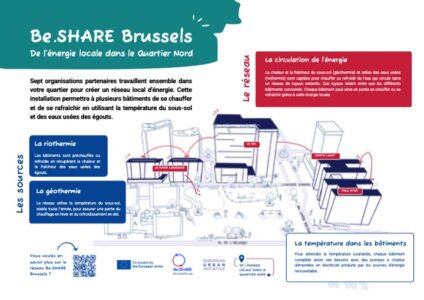
Be.SHARE explained to users of the connected buildings © EUI Be.SHARE
7. What’s ahead of Be.SHARE?
Next year, Be.SHARE will focus on deploying the network and sourcing: the geothermal energy under the Maximillan Park and the riothermal energy in the sewer collector. This will go hand in hand with the finalisation of the legal framework and the business model for its operation. In parallel, the partners will continue working with residents to support them in managing their energy consumption, while at the same time as inviting them to take part in the Be.SHARE lab, kicking-off early 2027. In other words, by the end of year 2, all the preparatory works will be implemented, paving the way for a full test in 2028!
8. Let’s SHARE in Brussels!
As we saw, deploying a 5th generation CNHCN is a complex combination of technological, legal, governance, and social elements which need to on the one hand be created from scratch, on the other to be adapted in a timely, relevant and feasible way. Stay tuned for the next publications to learn more about the ways Be.SHARE have gone about it, and why not subscribing to the Be.SHARE newsletter?!
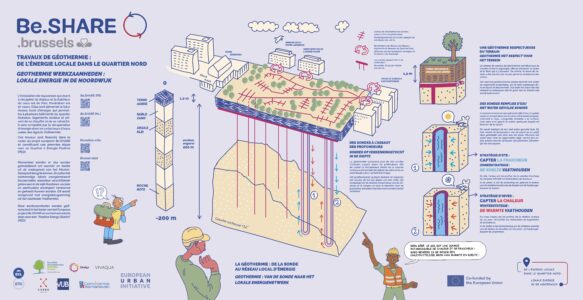
Be.SHARE explained to a technical audience © EUI Be.SHARE