
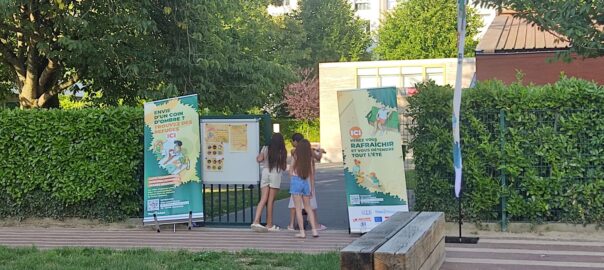
Usually, you enter a school, when you are a pupil or a teacher. You go there to learn in classrooms, play in the schoolyards during breaks. As an adult, you don’t know how the inside of the school – building and yard – look like.
You go to a library to read, study or work, benefit from some calm and access to a variety of useful resources. You go to a museum to get acquainted or deepen your knowledge with a topic, a period of time or an artist.
What if you could also enjoy these places to get some freshness in the summer? How would it look like? Would you still go there for the same types of activities? Could you, as an adult, access the schoolyards?
That’s what the EUI Time2Adapt project has experimented during summer 2024 and 2025 and that we are now deep diving into!
1. When else can you go to a schoolyard, library or museum?
Beyond the concept of OASIS schools– where schools are renovated and made greener, more climate resilient and more inclusive – which benefits pupils and teachers, selected schoolyards of Lille and Loos were open to the general public during the summers of 2024 and 2025 to benefit from the existing infrastructure (playgrounds, sport fields), as well as extra playing material and activities (Ecole Ariane Capon, école Jean Bart, école Perrault, école Michelet, école Sand-Daudet and école La Fontaine). They were open for some on weekends only, some also afternoons of weekdays or early evenings of weekdays. Some could also be open during heatwaves or bank holidays.
The Atrium of a museum (Palais des Beaux-Arts) was open when usually closed – on Tuesdays afternoon to demonstrate that a museum can also be a fresh place. The garden of a library (the Jean-Lévy library) was made accessible when the library itself is usually closed- on three Sundays afternoon – , in order to work on the safety of its content and test the opening of the garden, independently of the opening of library to further test wider uses of the place.
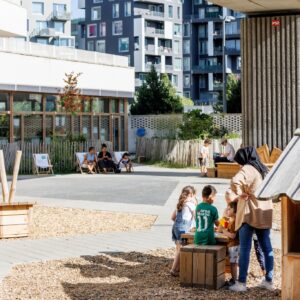
Ecole Ariane Capon © Ville de Lille
2. Why these places?
Time2Adapt seeks to expand the network of climate shelters of the European Metropolis of Lille by prioritising the most vulnerable areas and those most exposed to heat waves, particularly those with few or no cool spaces. The first learnings from prior experimentations such “Free courtyard, free garden” in 2023 and first school yard openings in Summer 2024 led to the selection criteria summarised in the table below for summer 2025 in terms of places to open, as well as modalities for such openings. These modalities will be reviewed based on the evaluation and feedback from the partners.
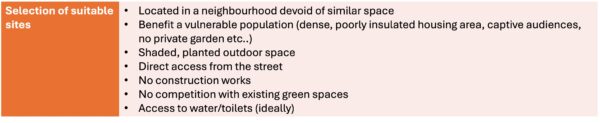
Selection criteria for schoolyards to be open in Summer 2025
3. Come and enjoy some activities!
It was observed that adults would not go the schoolyards and as such each school was encouraged to offer family-friendly events alongside the games, toys, and facilities already available on site. Specific activities were also organised on weekends:
- Sports activities: baby yoga, archery, Zumba classes, ping pong,
- Arts: circus arts; weaving, cartoonist
- As well as : Sophrology, an afternoon tea, a play, nature workshop, DIY workshop (bouquets of wildflowers, stick figures, bohemian decor)
- A cycling path to learn to ride a bicycle was organised.
In the garden the library, a truck provided access to books, and a staff member read stories. (Deck) chairs were displayed as well as board games distributed. The garden took advantage of events taking place concomitantly. In the atrium of the museum, visitors could also enjoy the pieces of art/frescoes displayed in the atrium, while access to the collections was closed. People could also use deckchairs to read and rest or tables to work.
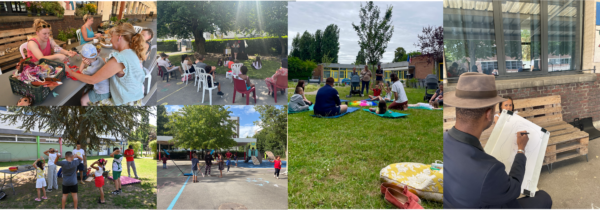
Various activities in Loos’ schoolyards © Ville de Loos
4. Get the right and well-equipped team onboard!
For the opening of the schoolyards, learnings from the first experimentations which took place in summer 2024, stressed the need to anticipate the planning of the teams present on site to ensure each schoolyard opening was composed of a team of at least two people – one civil servant and one summer job – with back-ups if needed. Another learning was to lengthen the contracts of the summer jobs from two weeks to one month, which reduced the HR and training time. City staff members were on call for any emergency and staff passed by regularly to check.
A kit was prepared with information and material such as a map of the school and its infrastructure (such as material storage, alarms), a hazard fiche, counting fiche, planning, list of contact details, and keys. It entailed more paperwork than in summer 2024 – when this did not exist , but this provided increased follow-up, feedback and wider base for evaluation of the scheme. Teams were also trained during an information session. Charters for correct usages of the spaces were also developed for some schools.
In total, the following staff were engaged:
- Schoolyards
- 16 summer jobs and 20 civil servants for four schoolyards in Loos
- eight people for two schoolyards in Lille
- Garden of the library: two security warrant and one staff member
- Atrium of the museum: six security warrants each time
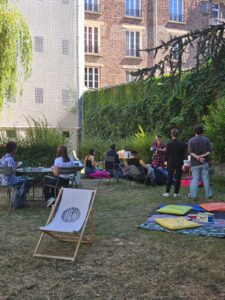
Opening of Jean-Lévy Library © Time2Adapt
5. Opening exceptionally during heatwaves
The City of Lille observed in 2024 that some of the schools would have needed to be opened on Mondays (when they were closed) because of unexpected heatwaves. In 2025, it therefore experimented an emergency opening schedule of schools through the activation of the Heatwave Plan of the Northen France area (Plan Canicule). When the Plan would go beyond the ‘orange alert’ threshold, the schools would open at the last minute, with the emergency recruitment of local staff. The Plan was activated only once on Monday 30 June, which is too small to assess its full extent, but has installed a procedure that can be used in upcoming years.
6. Testing the most suitable opening options
Other learnings from the summer 2024 experimentations were implemented in 2025. For example, the opening of one schoolyard was anticipated to 14.30 instead of from 17. Yet, it was observed that, overall, visitors come usually at the end of the day, after children’s naps and when the weather is overall cooler. New schoolyards were also tested which confirmed that the accessibility and visibility of the school is key to the success of its usage in summertime.
7. Now that they know this, will residents change their habits?
Visitors have enjoyed benefitting from these cool areas, appreciating the process of greening the schools in particular. Some were eager to question the fact that the school is closed during 2 months and not being used. For some, going to the schoolyards, library or museum in case of heatwave entered into residents’ practices, they find it great, and useful for children not going on holidays. It is to be noted though that the fact that some activities were organised in schools and the Jean Lévy library’s garden gave a purpose to come and discover them. Overall, the schoolyards are being used, yet, during very strong heatwaves, they would prefer the Atrium of the museum with air conditioning or parks (with experimental urban furniture).
Most of the schools were visited by families or mothers with children, or groups of children. In one school, which hosts a large sports complex, most of the visitors were men and boys. Visitors would be from the neighbourhood, some could plan to go from one school, to another, especially depending on the planning of the activities. An average of 20-240 person per day, depending on the school, came to the schoolyard, with peaks during events.
The Atrium of the museum was visited by 60 people on average on Tuesdays afternoon: elderly people, families with young children and toddlers. The garden of the library welcomed an average of 30 people each Sunday (elderly people, young people and teenagers) with peaks during events.
8. It’s only the beginning!
The opening of schoolyards is definitely a success: they might become increasingly accessible in the summer. This would also make the neighbourhood benefit from the newly green renovated schoolyards. Ideally, the garden of the library would be opened without surveillance, like a municipal park: yet ensuring residents treat it like a normal park and therefore stepping away from surveillance would take time.
Time2Adapt is also currently researching alternative organisational models (e.g. volunteering, mutualisation etc) for the opening of the different sites in the summer, to ensure their adequate coordination, safety and security measures as well as to actually address the needs of residents
Some schoolyards will reopen next Summer, their choice might depend on the evaluation, which is still to be fully carried out. As for libraries’ gardens and museum atriums, the assessment and decisions are yet to be taken.
What is certain, is that new experimentations will be carried out and that processes and learnings will be shared in Time2Adapt’s toolbox!
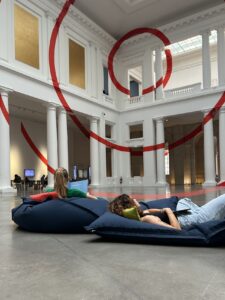
Atrium of Palais des Beaux-Arts © Time2Adapt
Reposted from Portico